

Description
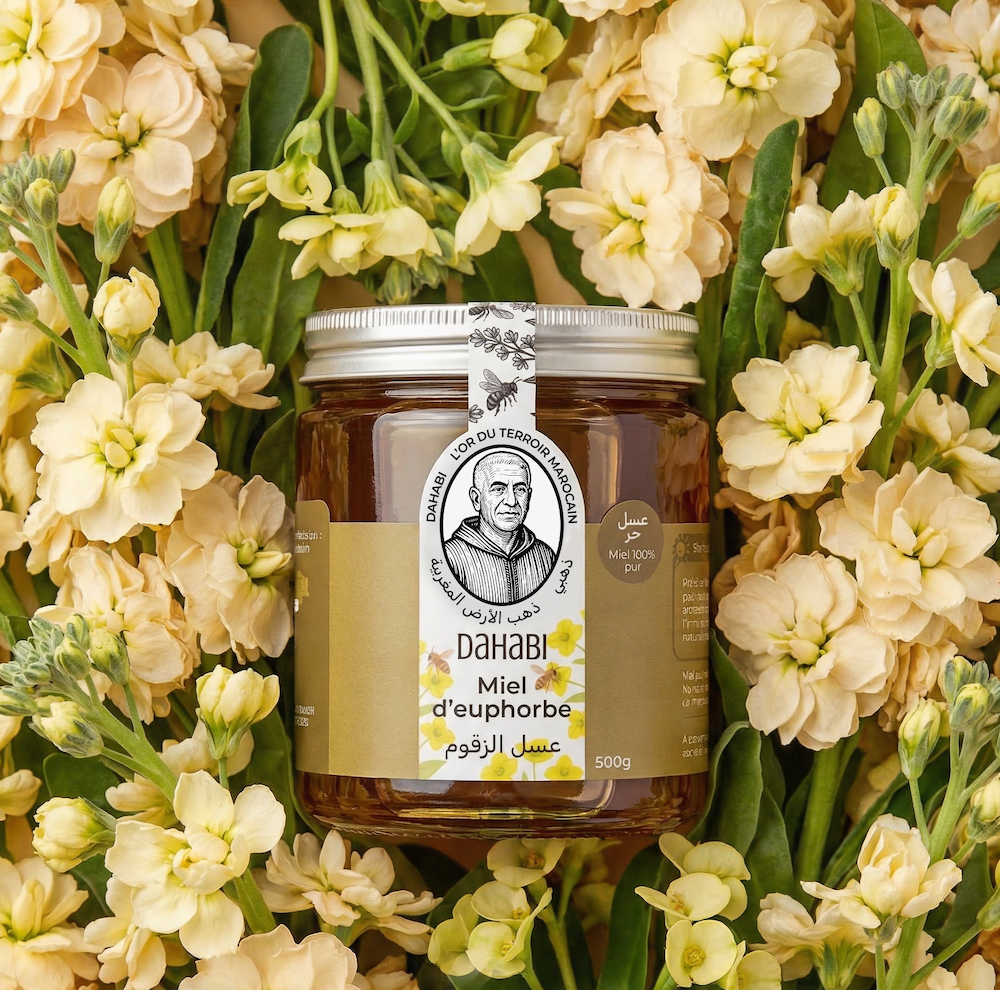
Euphorbia honey leaves a warm, sometimes tingling sensation at the back of the throat. That is its signature, and it is what people who know it come for. Its colour runs from dark amber to brown, its texture is thick.
It comes from the arid regions of southern Morocco, from the euphorbia flower known here as zqqoum. The plant grows wild, with no cultivation and no irrigation. The honey reaches the jar raw and unpasteurised, with nothing added.
How to use euphorbia honey
Neat, by the spoon, preferably in the morning. In a warm infusion, never in boiling water. Its taste does not suit everyone: it is blunt, almost sharp, and that is exactly what makes it a connoisseur’s honey.
Keep it in a dry place, away from light and heat. Do not give honey to children under 12 months.
Benefits of euphorbia honey
In southern Morocco people take it in winter, a spoonful on an empty stomach, and add it to thyme infusions. That use is old and well established; it is a cultural fact and we report it as one.
What can be measured: a phenolic and antioxidant concentration among the highest of Moroccan honeys, and 320 kcal per 100 g. The warmth in the throat comes from those compounds, not from any drug-like action.
We claim no effect on any illness. This is a food, it does not replace treatment, and breathing or digestive trouble that lasts calls for medical advice.
Average nutritional values per 100 g:
- Energy: 320 kcal (1360 kJ)
- Fat: 0 g
- of which saturated: 0 g
- Carbohydrates: 79 g
- of which sugars: 78 g
- Protein: 0.5 g
- Salt: 0 g


