

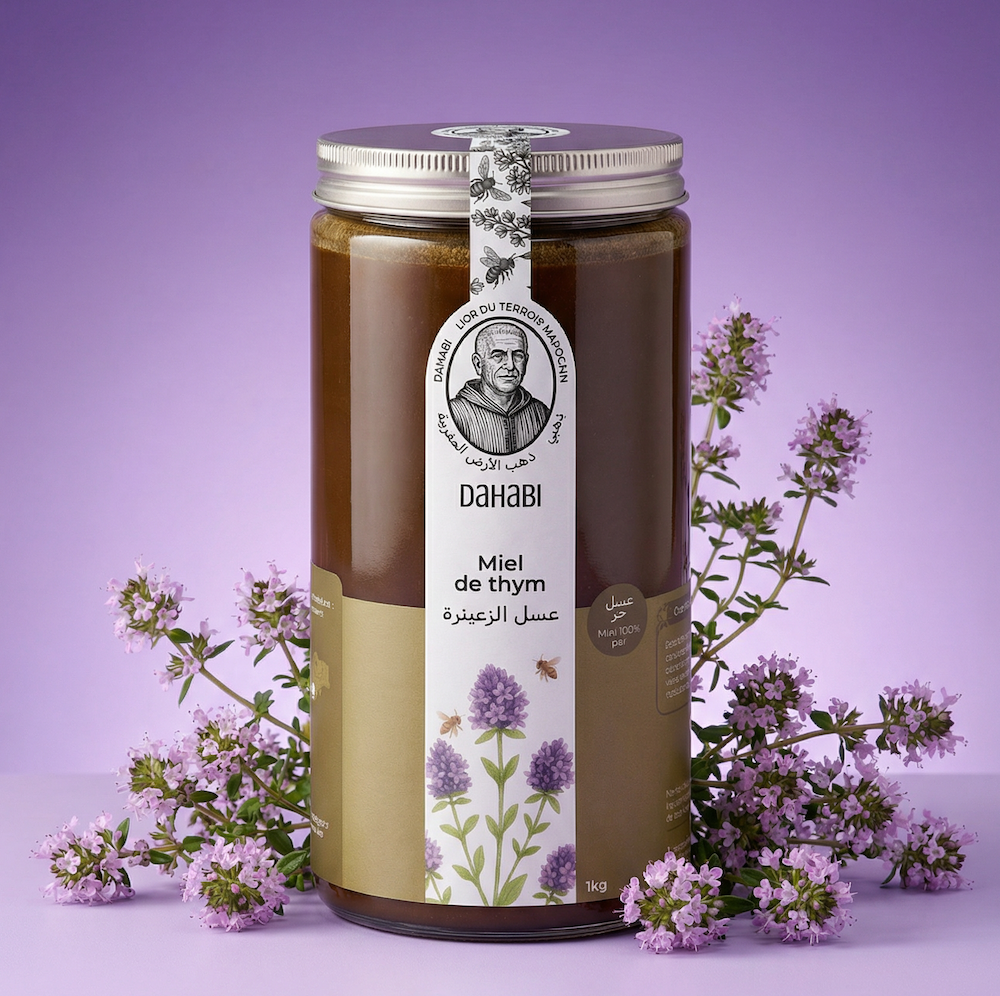
Description
Wild thyme flowers in April on the dry hills of Morocco, with no one planting it. Our beekeepers place the hives there for a few weeks, then move them on. The result is a dark honey, intense and faintly peppery, that leaves a warmth in the mouth.
The honey stays 100% natural, raw and unpasteurised. It keeps its enzymes, its scent and its colour, which pasteurising would partly destroy.
How to enjoy thyme honey
By the spoon, in a warm infusion, on goat’s cheese, in a vinaigrette with lemon. Its strength does the work: one teaspoon goes as far as two of a mild honey.
Available in 1 kg and 500 g. Store away from light and humidity. Do not give honey to children under 12 months.
Benefits of thyme honey
In Morocco this is the winter honey. A spoonful in hot tea when the throat feels rough, another in the morning when the cold sets in. The custom is old and it continues; we report it as such.
What analysis measures is more modest: dark honeys from aromatic plants hold more phenolic compounds than pale ones, and this one provides 320 kcal per 100 g, almost entirely as sugars. A measured content is not proof of an effect on any illness.
Thyme honey is a food. A cough that lasts or a fever calls for a doctor, not a jar of honey.
Average nutritional values per 100 g:
- Energy: 320 kcal (1360 kJ)
- Fat: 0 g
- of which saturated: 0 g
- Carbohydrates: 79 g
- of which sugars: 78 g
- Protein: 0.5 g
- Salt: 0 g


